
Accelerating writing
How I tried to improve my process for publishing articles about projects and learnings by leveraging modern platforms and AI

For the past few weeks and months I worked on projects, learned a lot but published nothing. However, publishing your work and learnings is really beneficial:
Exposure: You can reach a wider audience and showcase your expertise and skills.
Connection: You can network with other like-minded individuals and build relationships with your readers.
Education: You can help others learn from your insights and experiences, and also learn from their feedback and comments.
But publishing your blog posts can also be challenging. I didn't write anything because the friction of the publication process was just too high with my previous setup. It required me to update my personal website and took about 10 minutes. That was enough for me to never write anything, except on Twitter.
I didn't write anything because the friction of the publication process was just too high with my previous setup.
In this blog post, I will share with you how I have simplified and improved my publishing process by using Substack and a selection of AI tools. I will explain my goals, concepts, and plans for publishing my blog posts.
Goals of this project
My goal is to simplify and improve my publishing process by making it more efficient and effective.
I want to spend less time on technical issues and more time on writing quality content. I also aim to leverage the power of AI to enhance my creativity and productivity.
By improving my publishing process a little bit constantly, I hope to achieve a compound effect and accelerate my publishing cycle exponentially. Investing a bit into simplifying the process every day can lead to exponential results. This is the first step towards that goal.
By improving my publishing process a little bit constantly, I hope to achieve a compound effect and accelerate my publishing cycle exponentially.
Criteria
To achieve my goal, I have investigated the following main criteria for an optimal writing and publishing process:
Platform selection: You need to choose a platform that suits your needs and preferences, such as cost, features, design, and audience.
Writing process: You need to write engaging and informative content that attracts and retains your readers' attention.
Proofreading: You must check your grammar, spelling, punctuation, and style before publishing your posts.
Platform selection
Platform selection is the first step in publishing your blog posts. You should choose a platform that meets your requirements and expectations. Some of the criteria that I consider are:
Cost: How much does it cost to use the platform? Is it free or paid? Does it offer any discounts or incentives?
Features: What features does the platform offer? Does it have a newsletter integration, a high-quality editor, a social media integration, a draft sharing option, etc.?
Design: How does the platform look? Is it user-friendly and aesthetically pleasing? Does it have a customizable theme and layout?
Audience: Who are the readers of the platform? Are they interested in your niche and topics? How can you reach them and interact with them?
After comparing different platforms, I have decided to use Substack as my main platform for publishing my blog posts. Here are some of the reasons why I chose Substack over alternative approaches. I compared Substack with WordPress, Static Site Generators + GitHub pages and Publii in particular.
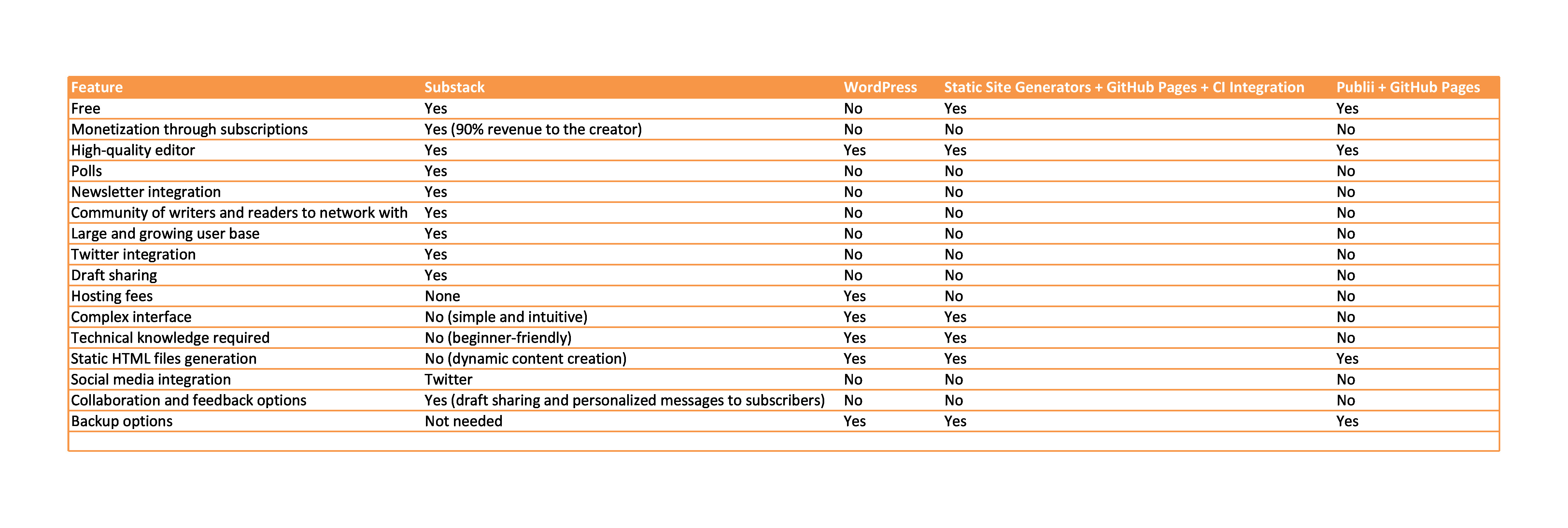
AI Integration
LLMs like ChatGPT have made significant improvements over the last couple of weeks and months. I want to integrate these tools as much as possible into my writing process so that I can focus on the creative work as much as possible.
During my research, I found ChatGPT and Writesonic to be particular good fits. Writesonic has some more specific features for generating ideas and paragraphs for a blog post and includes a free tier (most other providers don't). I'll use it when ChatGPT isn't enough.
My process for writing an article is as follows. I use Obsidian for as my writing program, as it is capable of handling markdown files.
Collect bullet points
Translate bullet points into paragraphs with Bing Chat or ChatGPT
Edit the paragraphs that need rephrasing or more detail manually
Add additional paragraphs that might be missing.
Proofread by friends and a LLM like ChatGPT and a spellchecker like LanguageTool
In fact, I followed this process to create this article, which you are reading right now!
Using AI for this article
The bullet points from step 1 for this article have been:
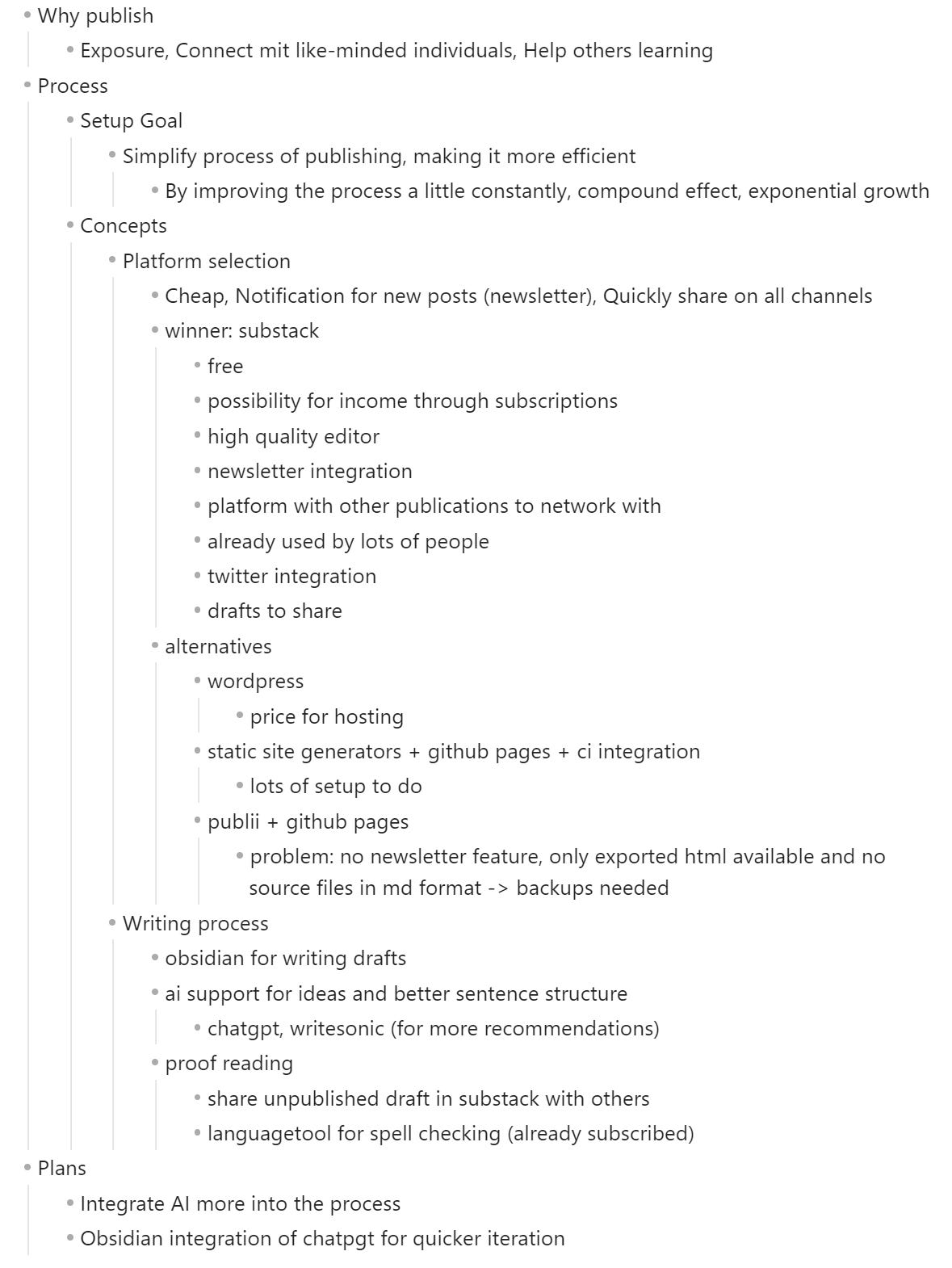
I used Bing Chat to convert my list of bullet points into a very rough first draft. I also used ChatGPT to create a table from the bullet points with the criteria for my decision to choose substack as the platform for publishing. This saved a lot of time!
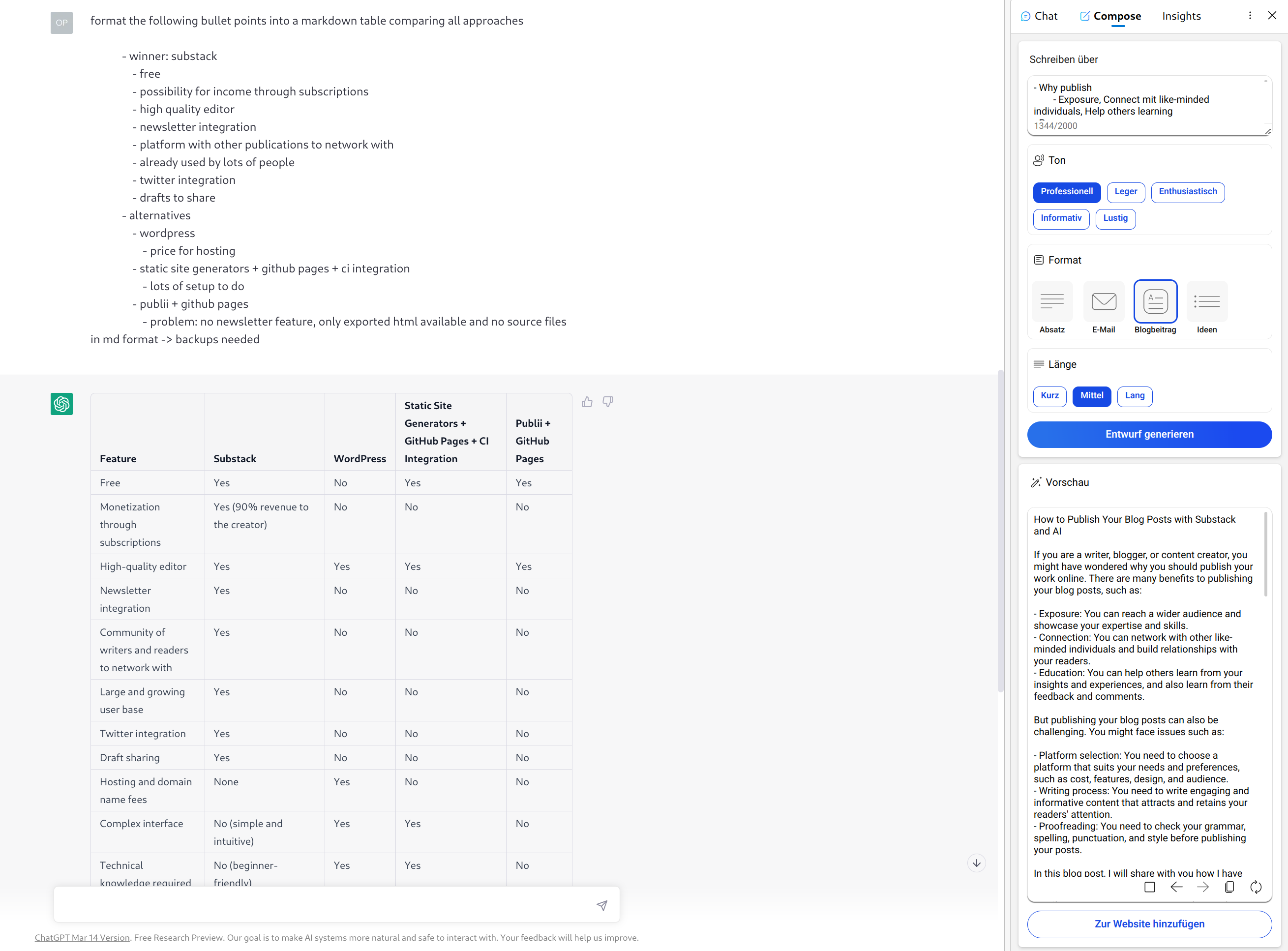
On the left you can see the prompt to convert the bullet points into a table, on the right the Bing Chat prompt to create a draft for this article.
After generating the draft, I had a good starting point and I continued editing paragraphs and writing more on my own.
Of course, this process should be adapted based on the scope of the article. If it is a highly detailed article that is critical to get right, you should definitely edit the AI output more to achieve sufficient quality. I just think that in the current era of LLMs, we as writers shouldn't be focused on the exact style and wording of our sentences where it's not necessary, and instead provide quality sources and ideas that can be formed into easy to understand and exciting articles.
I just think that in the current era of LLMs, we as writers shouldn't be focused on the exact style and wording of our sentences where it's not necessary, and instead provide quality sources and ideas that can be formed into easy to understand and exciting articles.
Plans
The current approach is a lot better than my previous system and helped me to get things done more quickly. Specifically, it reduces the friction of publishing an article on a high-quality platform where readers enjoy consuming content, and it’s easier to network. However, there are still plenty of ideas to implement in the future.
I think that finding more ways to integrate AI into the writing process could help, e.g. creating custom prompts for specific use cases. Moreover, a system for collection and structuring ideas before starting the actual writing process could be helpful, possibly also leveraging AI.